Role-Controlled Dialogue Speech Synthesis with Time-Conditioned Attention Refresh
Abstract
In two-speaker dialogue synthesis, the role tags [S1] and [S2] bind utterances to the first and second reference voices, respectively.
In our compact, non-autoregressive ZipVoice-Dialog baseline, a turn-based role channel agrees with these tags on S1-first alternating sequences but can conflict with them when speakers change order or take consecutive turns. We introduce explicit role conditioning (RC), which follows the most recent speaker tag, projects role and text features separately, and attenuates the direct role signal over flow time. To adapt reused attention to evolving features, we introduce time-conditioned attention refresh (TAR).
TAR predicts a low-rank score correction from within-block feature changes and flow time, refreshing only the second self-attention in each block.
Comparisons on OpenDialog indicate that RC improves fixed-reference role binding under changed turn orders.
Adding TAR to RC lowers word error rate and increases speaker-similarity scores on the original English test set. The combined model requires less generation time than full attention recomputation, with a slightly higher word error rate.
Model Overview
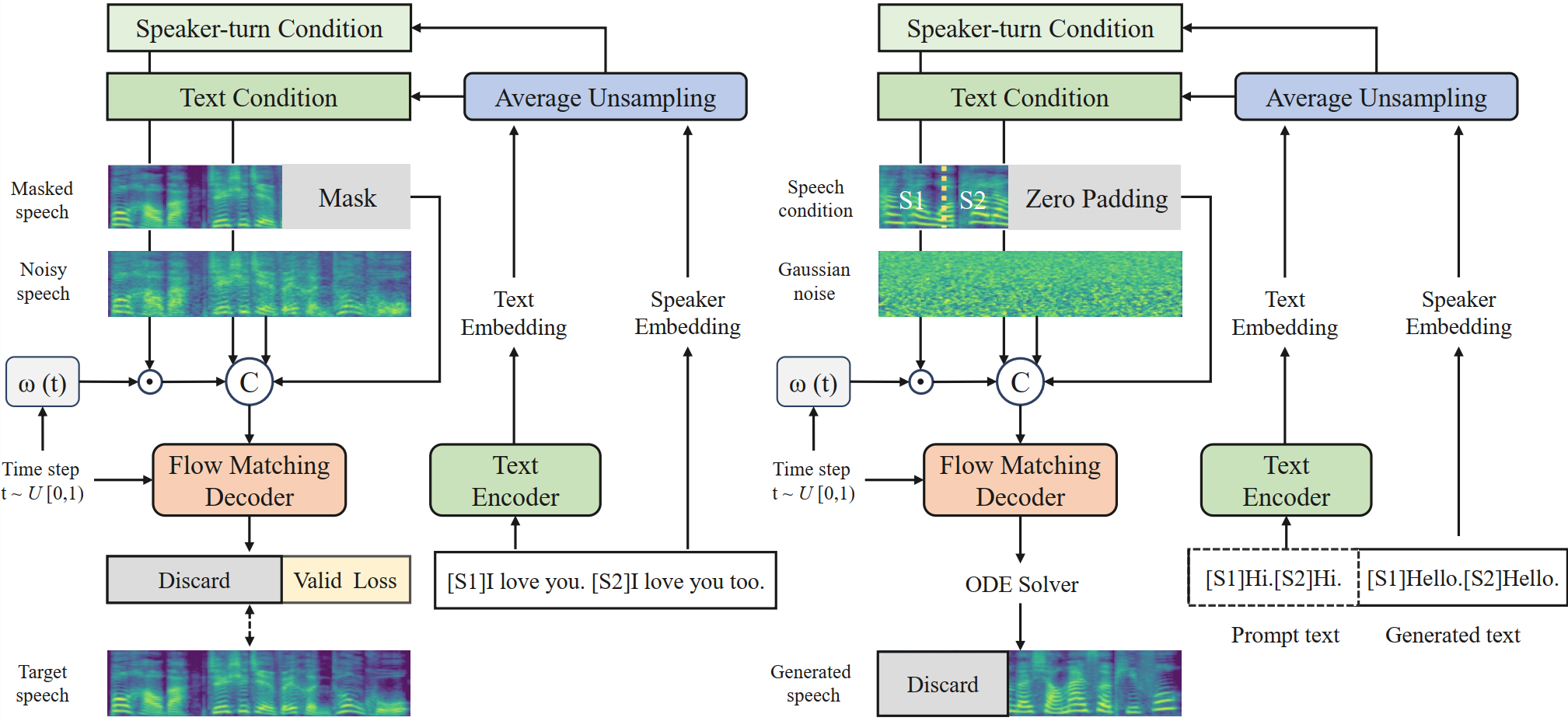
Architecture: The training stage (left) with conditional flow matching and the inference process (right) using an ODE solver.
Dialogue Generation (Chinese)
| Prompt S1 | Prompt S2 | Dialogue Text | Ours | ZipVoice-Dialog | FireRedTTS2 | MOSS-TTSDv0.7 | VibeVoice-1.5B |
|---|---|---|---|---|---|---|---|
| [S1]你好,今天过得怎么样? [S2]还不错,刚完成了一些工作。你呢? [S1]我也差不多,不过有点累了。你午饭吃了什么? [S2]吃了个沙拉,挺清淡的。你呢? [S1]我吃了汉堡,可能今天得加倍锻炼了哈。 [S2]看来你是得好好动起来了。 | |||||||
| [S1]好骄傲呀。 [S2]其实确实就是根据他们的那种曲调想填输入的词,那个感觉会有和他们有一点心灵相通的感觉。 [S1]对尤其是你写那个词的话你,因为是你自己写的话你就会觉得嗯更加的有成就感,然后感觉跟他们离了更进一步有没? [S2]对对对就是有,会有这种感觉。 |
Dialogue Generation (English)
| Prompt S1 | Prompt S2 | Dialogue Text | Ours | ZipVoice-Dialog | FireRedTTS2 | MOSS-TTSDv0.7 | VibeVoice-1.5B |
|---|---|---|---|---|---|---|---|
| [S1]Hello girl. [S2]So what do you spend your money on? [S1]Uh,well, obviously food, clothing, and many things like that. [S2]You spend your- Don't your parents do that? [S1]Well. | |||||||
| [S1] What kind of, um, what's your favorite kind of food, I guess? [S2]Favorite kind of food? Uh, maybe like barbecue, like steak or something, probably. [S1]Have you spent, do you spend money? [S2]Anything meat. [S1]Meat. [S2]Yeah, there we go. I spend my own money on boba sometimes. |
Speaker Controllability
The baseline model (ZipVoice-Dialog) tends to rely on the fixed temporal order of the spliced prompts, often failing to follow explicit speaker labels when the turn-taking pattern changes. In contrast, our model demonstrates true Label-Driven Controllability. By disentangling the speaker-turn condition, our model can accurately switch speakers based on the assigned labels (e.g., [S1] or [S2]) regardless of the original prompt sequence. This proves that our framework has successfully learned to model speaker identity through labels rather than simply relying on turn-based heuristics.
| Prompt S1 | Prompt S2 | Dialogue Text | Ours | ZipVoice-Dialog |
|---|---|---|---|---|
| [S2] What kind of, um, what's your favorite kind of food, I guess? [S1]Favorite kind of food? Uh, maybe like barbecue, like steak or something, probably. [S2]Have you spent, do you spend money? [S1]Anything meat. | ||||
| [S1] What kind of, um, what's your favorite kind of food, I guess? [S1]Favorite kind of food? Uh, maybe like barbecue, like steak or something, probably. |